
Tell me, O Muse, of that many-sided hero who traveled far and wide… (Odyssey 1.1)
Quality Assurance (“QA”) is a quest for improvement driven by findings.
In ancient times, the earliest forms of writing attest the certification of quantity and quality of stored goods. Today, we routinely record vast amounts of transactions in digital containers: they too need to be tested to assure quality against agreed standards, so that we can use the findings to build trust and refine our processes.
A Data Management perspective
Then and now, QA depends on good data management. This, in turn, requires navigating many challenges associated with people, processes and technology – a journey of action, discovery, adaptation towards dynamic goals… an Odyssey?
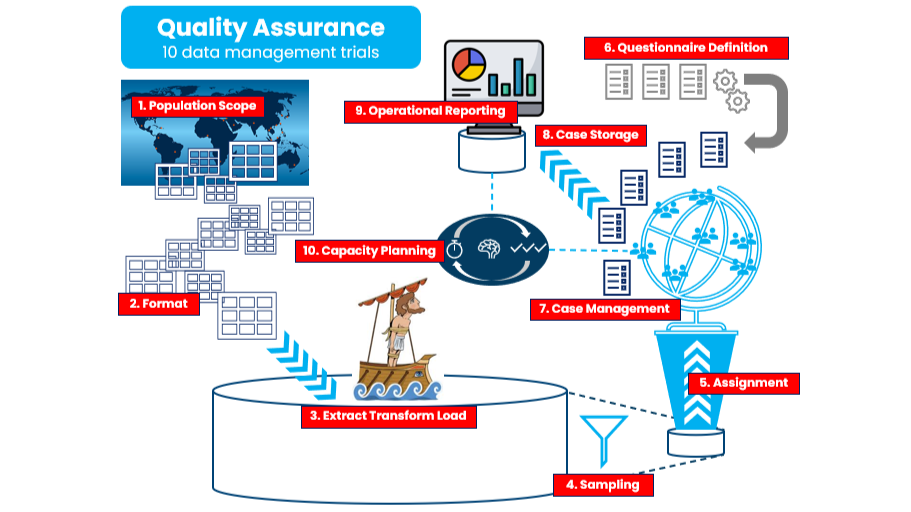
Setting our compass on a data management perspective, we will explore, in weekly blogs, 10 trials of a Quality Assurance Odyssey paired with episodes from the story of Odysseus:
- Population Scope (1. Lotus-Eaters): deciding what cases to test and at what level.
- Format (2. Cyclops): creating smart data structures to standardize handling.
- Extract, Transform, Load (3. Aeolus): funnelling a varied, continuous flow of cases into a unified database to facilitate Sampling and Case Management.
- Sampling (4. Circe): applying appropriate statistical methods, which may vary by business or process stream, to identify subsets of the cases for QA Testing.
- Assignment (5. Sirens): distributing the QA Testing work among teams of designated Testers, such that individual assignees have a balanced queue of work items.
- Questionnaire Definition (6. Scylla): defining and maintaining LOB and stream-specific QA Testing questionnaires.
- Case Management (7. Hermes): using questionnaires that Testers will fill out for each sampled case in their queue; that Operations personnel will verify; that Managers will close according to agreed workflows.
- Case Storage (8. Calypso): maintaining digital copies of the questionnaires for a period compliant with rules and regulations.
- Operational Reporting (9. Demodocus): deploying dashboards to stay on top of end-to-end workflows in real time.
- Capacity Management (10. Ithaca): an
To find out more about each trial, follow the link. If there is no link yet, it will appear soon, like Hermes helping Odysseus to move on when he got stuck along the way. Can’t wait? DM me for the full epic.
Caveat
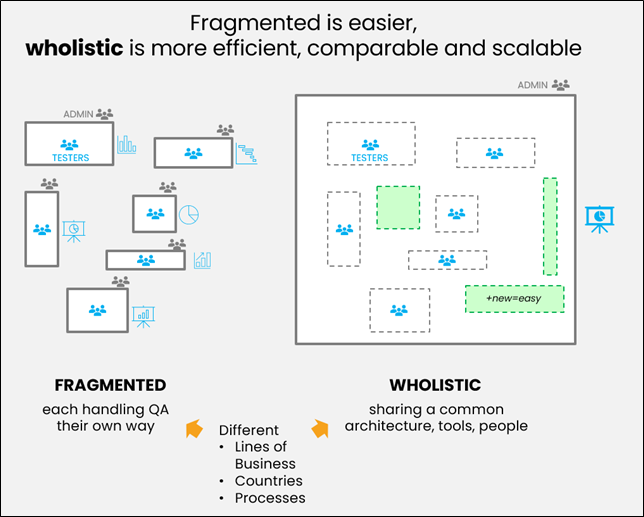
It is often the case that organizations adopt a fragmented (business/process/country-aligned) approach to QA. In this journey, we are advocating the wholistic route as the more efficient, comparable, scalable way to coordinate QA efforts.